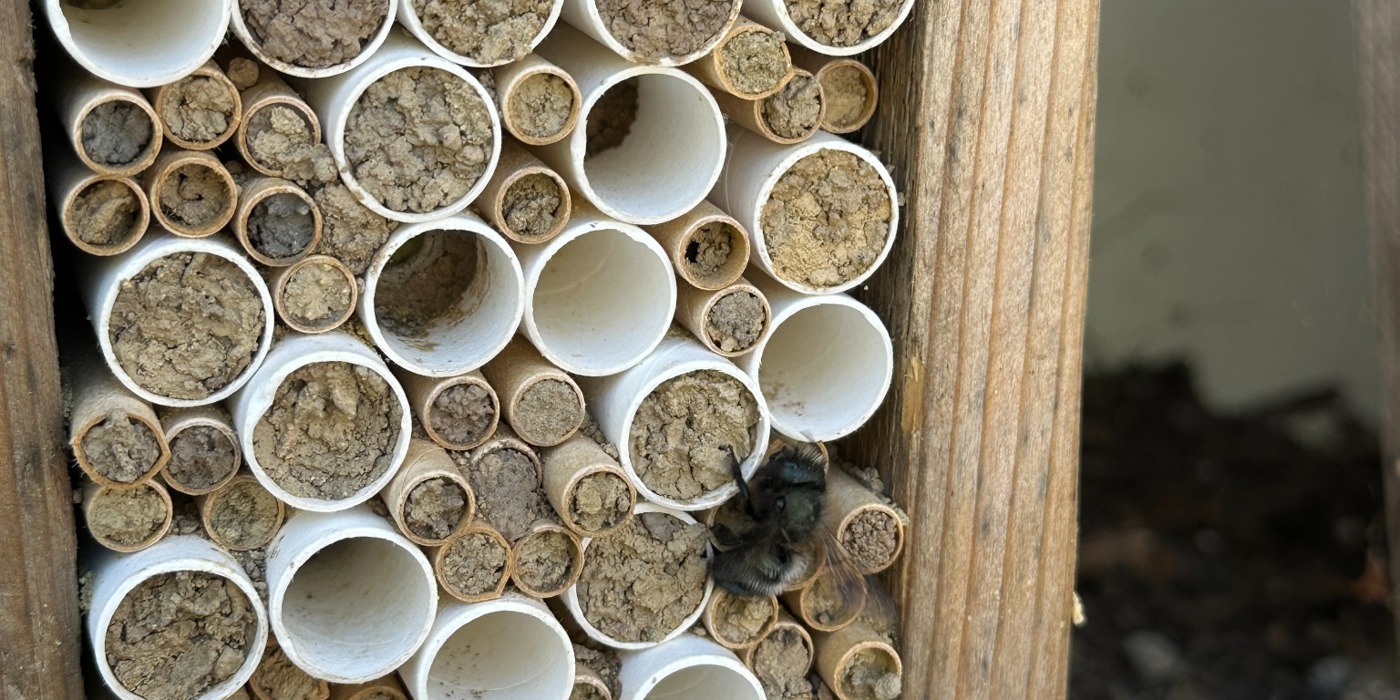
A bee house is a year-round responsibility. Explore our paper-straw setup, habitat choices and the important difference between developing spring nests and mature overwintering cocoons.
Steve’s spring photograph. Nest cutaways and winter-storage graphics in the video are illustrations.
Meet the blue orchard bee
This guide focuses on the blue orchard mason bee, Osmia lignaria. “Mason bee” covers more than one species, and not every metallic-looking bee can be identified from a garden photograph.
Blue orchard bees are solitary: each female provisions her own nest rather than joining a honey-producing hive. A female places pollen and nectar with an egg, separates the cell with mud, and repeats the process along the cavity. These bees are generally gentle, but avoid squeezing or trapping them; they can sting. [1]
Start with food and habitat
Put flowers ahead of accessories. Blue orchard bees need nectar, pollen and moist soil for their nesting work. A short burst of fruit blossom followed by a gap in flowers can leave the site without the resources they need. Plan spring flowering plants near the nesting area. [2]
A bee house is also only one kind of habitat. Other wild bees use soil, dead stems or cavities in wood. Leaving suitable dead stems and some undisturbed ground can support bees that will never use the tubes in a purchased house. [3]
Habitat first; maintain the homes you already have
The David Suzuki Foundation now recommends habitat over new garden bee houses, citing the potential for artificial nesting aggregations to spread disease and mites. That does not remove our responsibility for existing occupied nests. If you already manage a house, keep it serviceable and follow species-specific care. Leaving suitable natural nesting places is a useful option alongside managed pollination. [4]
Build something you can maintain
For blue orchard mason bees, choose smooth nesting cavities approximately 15 cm long and 8 mm in internal diameter, closed at the back. A firm mount, a protective roof overhang and breathable materials matter. Removable paper tubes or opening trays make later care possible; permanently glued nesting materials make that job difficult. Avoid glass and plastic straws that trap condensation. [4]
Steve has made houses using paper straws, and the photographs show the resulting setup in use. Before copying any homemade design, check the actual internal diameter, tunnel length, backing and whether the tubes can be opened or replaced. An ordinary drinking straw is not automatically a suitable nesting tube.
Choose the location before nesting starts
Use a dry, sheltered position with morning warmth and protection from rain and strong wind. Install the house securely rather than letting it swing. Think about roof runoff and irrigation as well as the direction the entrance faces. [1,4]
Once bees are actively nesting, watch from a comfortable distance. For maintenance or seasonal movement, follow guidance for the identified species and development stage; careless handling of young nests can dislodge developing bees from their food. [5]
Where can Canadian gardeners get cocoons?
Start by making the garden welcoming to local bees. Buying cocoons is an option, rather than a requirement.
Two Canadian supplier leads are West Coast Seeds and Vancouver Island's West Coast Plants. At our October 19 check, West Coast Seeds showed unavailable/notify-when-available, and West Coast Plants showed sold out with pickup variants marked for February-March 2027. These are seasonal leads, not stock promises or endorsements. Ask about species, regional origin, health checks, collection or shipping, and complete care instructions. Locally adapted bees are preferable to moving bees between very different climates. [2,6,7]
Have flowers and the nesting site ready before release. Follow local bloom and weather conditions and the supplier’s species-specific instructions.
Overwintering starts with the right stage
A mud-capped spring nest is not ready to be treated like a container of mature winter cocoons. Blue orchard bees continue developing through summer and eventually overwinter as adults inside cocoons. [2]
For managed blue orchard nests, autumn is the time to follow a suitable guide for opening, inspection and cocoon care. Oregon State describes winter refrigeration at about 4°C, with ventilation and approximately 60–70% relative humidity, checked about every two weeks. Use a thermometer and humidity monitor; keep the moisture source separate so cocoons do not soak. Prevent both drying out and excessive wetness; do not freeze cocoons. West Coast Seeds describes 2-4°C storage for its dormant stock. These are managed-care instructions, not a reason to refrigerate unidentified or immature nests. [1,8]
Do not apply that routine to every unknown occupant of a mixed bee hotel. Leafcutter nests, for example, have different overwintering requirements. If identification is uncertain, get advice before opening or refrigerating them. Replace disposable nesting materials after the occupants have emerged, and clean reusable systems according to their instructions. [5]
A useful yearly rhythm
Think of the work as a cycle: prepare habitat and nesting materials before spring, observe activity, protect developing nests appropriately, then plan autumn and winter care for the species you actually have.
The companion video combines Steve’s real spring footage and photographs with explanatory graphics. The animated opening, nest cutaway and storage diagram are illustrations. Our spring material does not demonstrate autumn cleaning, prove species identification, or measure winter survival.
For winter cleaning, use the detailed species-specific instructions in the references below. This article does not supply a chemical treatment recipe. Do not dismantle an active nest for a photograph or assume every cocoon in a mixed hotel is a blue orchard bee.